

Agile in a Small Team: What We Kept and Dropped
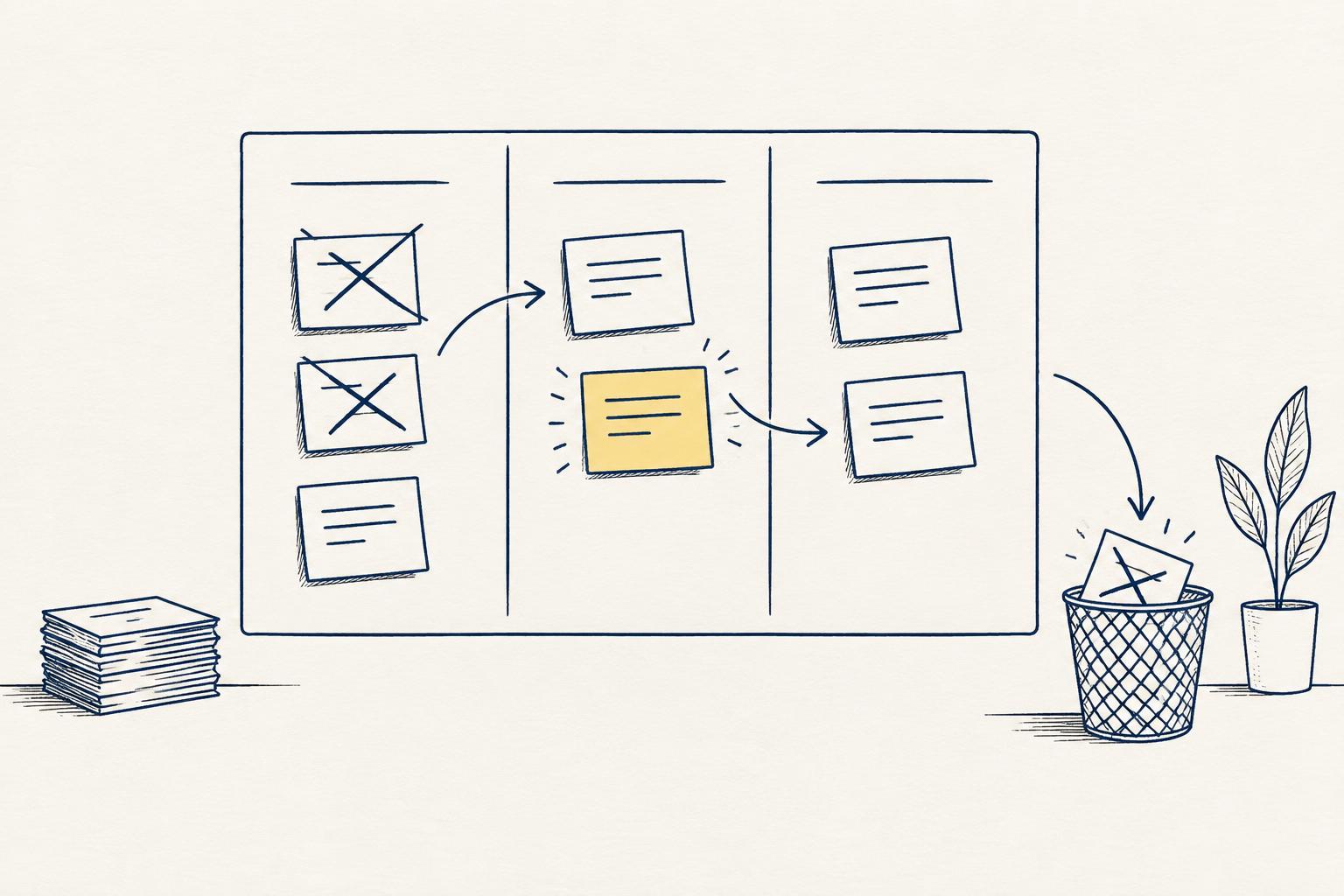
Agile methods can help a small team move with purpose. They can also create meetings, false promises and a board that nobody trusts. The difference is not whether you call your work Scrum, Kanban or agile. It is whether the method helps you make better decisions when priorities change.
For a team handling software work and inbound leads, change is normal. A new lead may need a fast response. A client may uncover an issue. An internal improvement may matter, but not today. We learned that a lightweight system works best when it shows the real work, protects focus and makes trade-offs visible. This is what we kept, what we removed and what went wrong before we simplified it.
• Keep a visible workflow that reflects how work actually moves.
• Drop sprint promises when urgent work can enter at any time.
• Keep planning short and tied to clear decisions.
• Separate lead response from planned delivery work.
• Review outcomes and blocked work, not ceremony attendance.
We kept a visible flow of work
Keep one shared view of active work. It is the simplest way to stop priorities living only in people's heads.
A small team does not need a detailed project office. It does need a place where everyone can see what is waiting, what is being worked on, what is blocked and what is ready for review. That view should include client work, internal work, fixes and work caused by new leads. If it leaves out the inconvenient work, it becomes a reporting tool rather than a decision tool.
At Seamless Doubt, the useful lesson was not that every task needed a card. It was that unclear work created more delay than a basic board ever did. When a request arrived through a form, the team needed to know who owned the response, what information was missing and whether the request could interrupt planned work.
A board should expose pressure, not hide it
A board is useful when it makes overload obvious. If every item is marked as urgent, the board tells you nothing. If work stays in progress for too long, that is not a reason to redraw the board. It is a reason to ask what is blocking progress.
We also stopped treating the board as a list of activity. The important question is not whether everyone looks busy. It is whether the most valuable work is moving to a useful outcome.
We stopped treating sprints as promises
Do not promise a fixed set of work if your team must respond to changing demands. A sprint can provide focus, but it should not become a contract with reality.
This was one of the parts that went wrong for us. We planned work with care, then a high-value conversation, a support issue or a change in client needs arrived. The new work was real. Yet the planned work still sat there, making the team appear late even when they had made a sensible choice.
That pattern creates a poor habit. People begin to protect estimates, defend old plans or hide unplanned work so the sprint looks successful. None of that helps the customer or the business.
We kept the idea of a planning horizon. We dropped the idea that it could predict everything. Planned work gives direction. It does not remove the need to choose again when new information arrives.
Make interruption a named decision
Urgent work should not quietly enter the queue. Someone should decide whether it deserves to interrupt current work, who will handle it and what will move as a result.
This matters for inbound leads. A quick reply may be more valuable than finishing a lower-priority internal task. But that should be a visible trade-off, not an accidental one. When you name the trade-off, you can learn from it later.
We kept planning, but dropped long ceremonies
Plan often enough to make decisions, then return to the work. Meetings should reduce uncertainty, not become proof that the team is organised.
Long planning sessions often fail in small teams because they try to answer questions that cannot yet be answered. A request may still need discovery. A client may need to clarify an outcome. A technical choice may depend on a test or a conversation. Pretending otherwise produces detailed plans with weak foundations.
We now value short planning conversations with a clear purpose. What matters most now? What can wait? What is blocked? Who needs to decide? These questions are more useful than a long debate about whether every item is fully estimated.
Define work before you schedule it
A task is ready when the team understands the outcome, the owner and the next useful action. It does not need every detail decided in advance.
For example, a lead request may be ready for a response before it is ready for a full proposal. The next action could be a call, a question or a quick check of the prospect's existing process. Treating that early step as real work prevents leads from disappearing into an undefined backlog.
We separated lead response from delivery work
Give incoming leads a clear path. Otherwise, they will either disrupt everything or receive a slow and inconsistent response.
For an owner or operations director, this is often the practical issue. Your team may have a sensible delivery plan, but a form submission has its own clock. The prospect expects acknowledgement, context and a next step. If no one owns that process, the request may sit between sales, operations and delivery.
We found that lead handling needs its own simple workflow. Capture the request. Check whether it is a fit. Assign an owner. Agree the next response. Record the outcome. This can be visible beside delivery work without being mixed into the same priority queue.
The point is not to make every lead a project. It is to make sure every lead has a clear next action. That reduces hand-offs and avoids the common problem of chasing context after a promising enquiry has gone quiet.
We made reviews about evidence, not ritual
Review what changed, what was learned and what needs a decision. Do not run a review simply because the calendar says so.
A useful review looks at completed work in the context of the intended outcome. Did the change solve the problem? Did the lead receive a useful response? Did a blocked item remain blocked because no one could make a decision? These questions produce action.
The review format itself matters less than honesty. We had to learn that a quiet board was not always a sign of smooth delivery. Sometimes it meant work had not been updated. Sometimes it meant people were waiting for approval. Sometimes it meant the task was too vague to move.
A good review makes those facts safe to discuss. It should not become a search for someone to blame. If the same blockage appears again, improve the system around it. Clarify ownership, reduce a hand-off or change how requests enter the team.
Frequently asked questions
Should a small team use Scrum or Kanban?
Start with the problem you need to solve. If work arrives unpredictably, a flow-based approach is often easier to manage. If your work can be grouped around a stable goal, a sprint rhythm may help. You can also borrow useful parts from both without adopting every ceremony.
How should we handle urgent inbound leads?
Create a named owner and a clear response path. Decide what qualifies as urgent, what information is needed before a reply and when delivery work may be interrupted. Make the decision visible so the team understands what moved and why.
What should we remove first from our agile process?
Remove any meeting, report or rule that does not help the team decide, deliver or learn. Do this carefully. Replace it with a simpler habit, such as a short priority check or a visible blocked-work list. The aim is less waste, not less discipline.
Conclusion
Keep the parts of agile that make work visible, choices clear and feedback useful. Drop the parts that ask a small team to act as though change will not happen.
Start by mapping how work enters your team, including inbound leads. Create a shared view of active work. Set a clear owner for each new request. Then review where work gets stuck and what repeatedly interrupts delivery. You do not need a larger process. You need a process that tells the truth about how your team works.